Two-Thirds Use AI. Seven Percent Actually Use It.
Reading time: about 6 minutes.
A bookkeeper at a 40-person Danish firm has ChatGPT open in one tab and the invoicing system open in another. She copies numbers between them by hand, same as she did last year. Ask her if the company "uses AI" and she says yes, of course, everyone does now. Ask her if AI touches the invoice that just came in and she laughs. Nobody connected the two tabs. Nobody was going to; that was never anyone's job.
TL;DR
Two-thirds of Danish SMEs report using AI. Only 7% of those have it actually built into a working process. The other 93% have a subscription sitting next to the work, not inside it, and that gap, not lack of awareness, is where the money and the risk both sit.
- Adoption is not the problem anymore. 67% of Danish SMEs already use at least one AI tool. The "should we try AI" conversation is over.
- Depth is the problem. Only 7% of adopters have AI integrated into both an internal process and a product or service, not just a browser tab someone opens occasionally.
- A chat tab is not a system. A system reads the actual document, writes to the actual record, and someone downstream trusts the output without double-checking it by hand.
- This gap is exactly where a failed first attempt sits. Small business AI adoption dropped from 42% to 28% between 2024 and 2025; cost and complexity are the stated reasons, and a chat tab that never got wired in is a common shape of that failure.
- The EU AI Act does not wait for you to close this gap. It becomes fully applicable on 2 August 2026, with no exemption for company size.
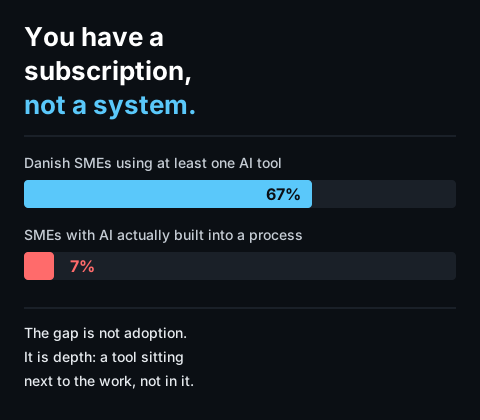
Two numbers, same survey. The second one is the one that matters.
What This Article Answers
- Is "two-thirds of SMEs use AI" actually true, or a survey trick? (True, and it undersells the point rather than overselling it.)
- What does "7% have it integrated" actually mean in practice?
- Why did a chat tab open all day still count as "using AI" in that 67%?
- Is this specific to Denmark, or true everywhere?
- Why did SME AI adoption drop between 2024 and 2025 if the tools got better?
- What changes on 2 August 2026, and does it apply to a 20-person company?
- If we're in the 93%, what's the actual next step, not the marketing one?
The Two Numbers Are Measuring Different Things
The 67% figure comes from a simple question: does anyone at the company use an AI tool for anything. A single employee running a client email through ChatGPT before sending it counts. So does a founder who tried an AI note-taker once at a conference and never opened it again. It is a low bar, and Danish SMEs clear it easily, ahead of the rest of the EU.
The 7% figure asks a completely different question: is AI inside both an internal process and something the company sells or delivers, in a way that runs without someone manually carrying information across the gap. That is a high bar, and almost nobody clears it. The distance between 67% and 7% is not measurement noise. It is the actual state of the market: nearly universal trial, almost no follow-through.
Why a Chat Tab Doesn't Count as a System
The bookkeeper's ChatGPT tab is genuinely useful to her. It drafts an email faster than she would alone. But it is not connected to anything: not the invoicing software, not the CRM, not the shared drive where contracts live. If she goes on holiday, the tab goes with her. Nothing was built; a habit was formed.
A system looks different in three specific ways:
- It reads the real input. The actual invoice PDF, the actual contract, not a paragraph someone retyped into a prompt box.
- It writes to the real output. The line item lands in the accounting system; the answer comes with the source page attached. Nobody re-enters it.
- Someone downstream trusts it enough not to redo the work by hand. This is the part that actually saves time. A tool that still gets double-checked line by line has not removed any labour, only added a step.
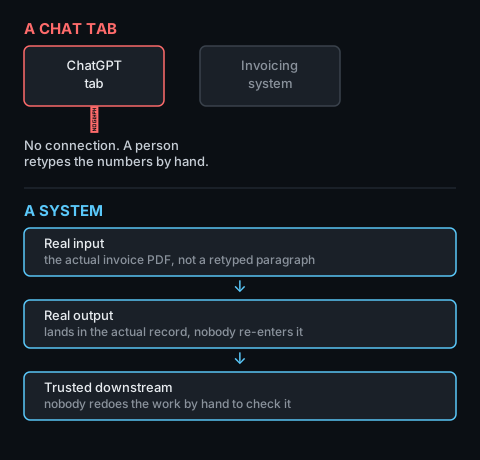
Same AI, different outcome. The difference is whether it's wired into anything.
None of this requires a research lab. It requires picking one document type, one process, and wiring the two tabs together properly. That is a project, not a subscription, and it is why so few companies have done it: buying a subscription to an AI tool is a five-minute decision, and building the connection is not. It is also why most "AI agents" in production turn out to be demos with extra steps: the demo proves the tab can talk to a model, not that anyone downstream trusts it enough to stop checking by hand.
Why Adoption Went Down, Not Up
If the tools got better and cheaper through 2025, adoption should have climbed. Instead, small business AI adoption fell from 42% to 28% year over year. Cost and complexity are the reasons companies give.
Read alongside the depth gap, this is not mysterious. A meaningful share of that 42% was the chat-tab kind of adoption: cheap to start, easy to try, and just as easy to quietly stop paying for once the novelty wears off and no process actually changed. Nearly a quarter of business owners report losing customers to AI tools their customers now use directly, and two-thirds worry AI makes their business feel less personal. That is not a market ready to buy another subscription. It is a market that tried the easy version, felt no structural change, and got more cautious, not less.
The companies that succeeded took a different path: 80% of the businesses that did integrate AI into a real process report measurable efficiency gains. The outcome is real and worth having. It just is not reachable from a browser tab, and it is the same reason most agentic projects can't defend their own ROI: nobody can point to the number a project never wired into a process actually moved.
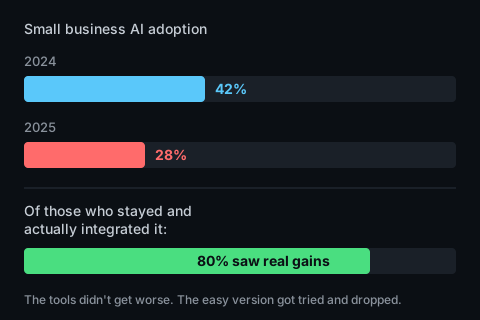
Adoption fell. The outcome for the people who stuck with it didn't.
What Changes on 2 August 2026
The EU AI Act becomes fully applicable for most obligations, including data and data governance requirements, from 2 August 2026. It applies regardless of company size: a simplified compliance track exists for companies up to 750 employees and EUR 150 million in revenue, which covers essentially the entire Danish SME market, but "simplified" is not "exempt." Documentation is still required. GDPR continues to apply in full to any personal data an AI system touches, whether that system was bought, built, or is just a tab someone opened.
A company still running everything through an unconnected chat tab has not avoided this by staying informal. If anything, informal use is harder to document after the fact than a system built with a defined input, output, and audit trail from the start.
What This Means If You're in the 93%
Being in the 93% is not a failure; it is the default, and the companies who already tried something and stopped are not behind, they are simply mid-decision. The next step is not "adopt AI," since that already happened. It is picking one specific, repetitive, document-heavy task, currently done by retyping information from one tab into another, and wiring it end to end: real input, real output, a human checking exceptions instead of checking everything.
That is a smaller project than it sounds, and a much smaller one than most companies assume before they have priced it. If the goal is genuinely adapting the business rather than buying another subscription to an AI tool, that adaptation has its own shape worth understanding first. The two-thirds already showed up to the first meeting. The 7% is the group that stayed for the second one.